The Product Journal by Nova Skye Nova Skye · Technical product manager Contact

Zero to one · 04 · Tiny Next

  1. Problem
  2. Bet
  3. Evidence
  4. Decisions
  5. Result

Write it once. It comes back when it matters.

A notes app for anyone with a full head, built alone from a first commit on 9 August to a live product, with two pivots and a third of the code removed in one tested release. It is a personal project: I keep building to get better at technical product management, without waiting for anyone else.

In short

57
live answers graded by hand; none invented where no note existed
10+
friends testing it
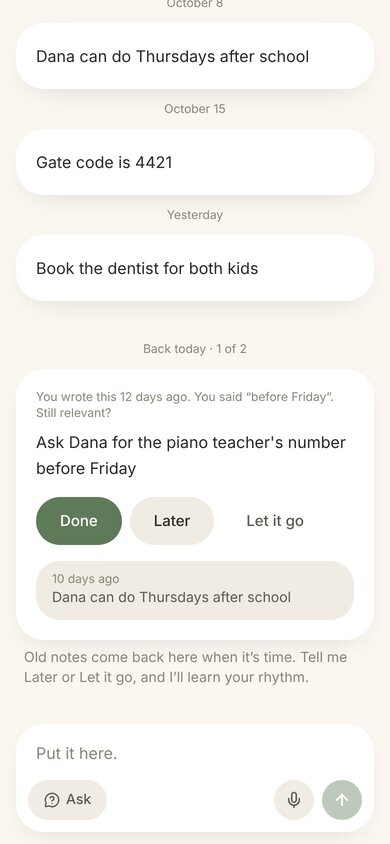
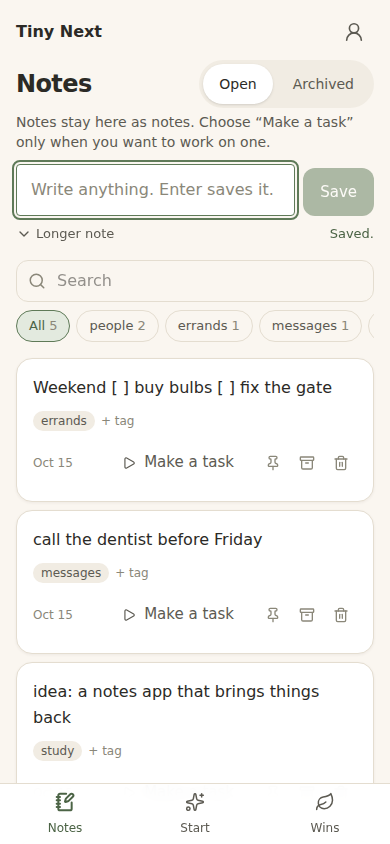
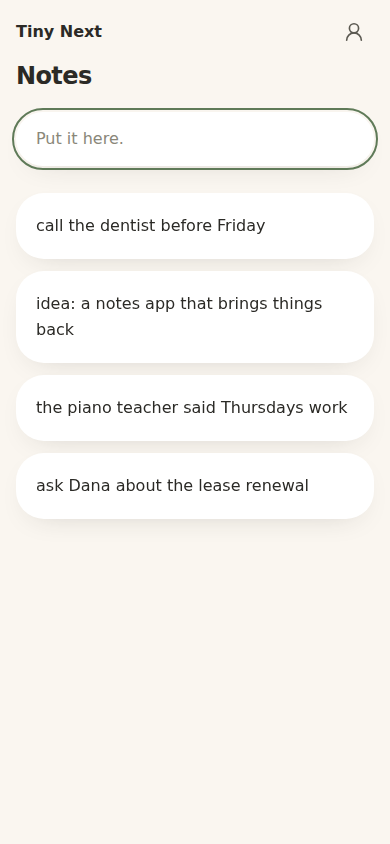
Version 3, September 2026: each note card carries a label, tags, Make a task, pin, archive and delete, under filter chips and three tabs Version 5, October 2026: one field that says Put it here, and four notes in plain cards Version 9, 18 October 2026: a note from twelve days ago comes back inside the stream with Done, Later and Let it go
September: a label, tags, a date and four buttons on a card for one line of the person's words. October: one field and a list. 18 October: a note from twelve days ago comes back with Done, Later and Let it go.Fig. 01
Stage
Live since 15 October 2026 · more than ten friends testing
My role
Set the standard every feature is judged by, found the problems by using it, made the calls, challenged results that looked too convenient
The bet
Notes come back on a rule you can read on the screen, and a guess is never shown as a fact
Early result
57 live answers graded by hand; none invented where no note existed
Technology
Next.js 16 · TypeScript · Supabase · Cloudflare Workers · Anthropic and OpenAI-compatible providers · Vitest, Playwright
Section The story Marginalia · the PM layer
1

The problem

I kept notes in a chat window with an AI and in free notes apps, and none of them ever brought a note back to me.

The product began as a tool for adults who struggle to start tasks: one tiny step, a five-minute timer, a history called Wins. Two pivots later, the part I came back to every day was writing things down.

2

The bet

A note that comes back on a rule the person can read, and an answer that always shows the note it came from, will be trusted where a guessed label was not.

It is working if the friends testing it still use it after a month and say what came back was worth seeing.

3

Measure the AI features, then remove the ones that lost

Five engines could read a note into fields: keyword rules, a trained classifier, a trained tagger, a 1 GB model running in the browser, and a cloud model. Thirty realistic notes with the right reading for each went through every engine with one scorer. Thirteen models in all, across two providers, for about one dollar. The table shows the rules, the browser model and three of the cloud models.

EngineKind right, of 30Written time right, of 30Invented peopleSeconds a noteCost per 1,000
Keyword rules2526190.01free
1 GB model in the browser1821015free
Cheapest cloud model252421.4$0.06
Mid cloud model302911.6$0.80
Largest cloud model303012.4$3.20

The rules treated every capitalized word as a name, and the 1 GB browser model copied the prompt's example sentence for seventeen notes. When a flagship model lost to cheaper ones I challenged the result and checked the harness: the prompt was ambiguous, and it compared models at different reasoning levels without recording it. The table shows the rerun, with the prompt rewritten and each model's reasoning level recorded. The mid-priced cloud model was chosen: as accurate as the largest on the kind of note, for a quarter of the cost.
4

Every version, 9 August to 2 November

VersionDateWhat the app wasThe product decision
19 AugOne tiny step, a five-minute timer, a Wins historyShip the step, timer and Wins loop first, open to guests
218 SepThe same app with a server that enforces plansAdd a server that enforces each plan's limits
327 SepNotes in front, the step engine behindNotes become the first screen; the step engine moves behind it
46 Oct"Help me remember": capture, come back, connect; new lookWrite the product page and the design brief first, as tests
59 OctOne field and a listCut the app to one field and a list; ship the cut as its own version
614 OctA conversation; ask your own notesReplace filled fields with Ask, which answers over the notes it shows
715 OctNotes come back by rules on dates; the site goes liveWrite a timing rule as a sentence, then as code
818 OctStronger written answers from AskMake the best version of Ask the default
918 OctOne screen; old notes come back inside itMerge the returning notes into the single screen
1023 OctTwo copies of every note; speed at 2,000 notesKeep two copies of every note and fix save speed at 2,000 notes before more model work
111–2 NovFinding by meaning; citations checked sentence by sentencePut the trust rule in code that runs after the model
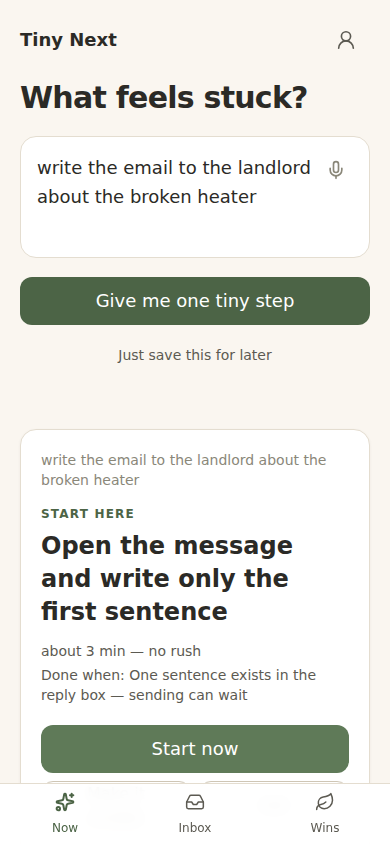
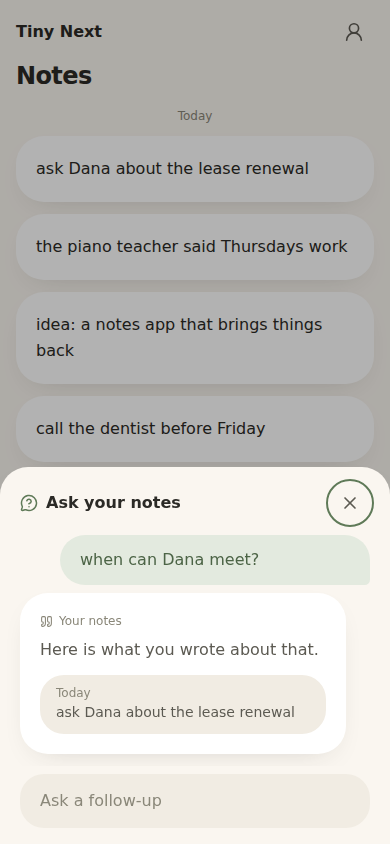
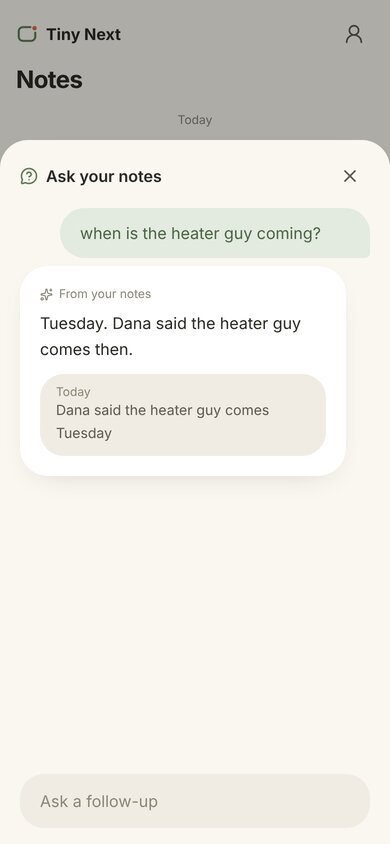
Version 1, August 2026: one tiny step with a done-when line and a time guess Version 6, October 2026: the Ask sheet, a question and the notes it found Version 8, October 2026: a written answer marked From your notes, above the note it came from

Version 1 in August; the Ask sheet in version 6; an answer that sits above the note it used, in version 8. Every screen taken from the code at that commit, on a phone.

5

The decision log

No.WhenDecisionWhyWhat followed
N-018 OctRemove the automatic label from notesI saw the model replace a correct label with no label and called it bad UX.Still stands
N-029 OctChoose the model that reads a note by measurement, and remove the engines that lostFive engines could read a note, and testing all of them on the same thirty notes cost about a dollar.A third of the source went, with all tests green.
N-039 OctThree kinds instead of four; drop the category field; resolve written times to a calendar dayA field is worth keeping only if a screen or a rule uses it.Five days later the fields themselves went (N-04).
N-0414 OctRemove the fields altogether; Ask answers from the person's own notes, always shown above themWhen a model fills a field, a wrong value looks like a fact. When it answers above the notes it used, the person can check it.Ask shipped in version 6; 57 live answers were graded by hand and none invented where no note existed.
N-0523 OctTwo copies of every note, broken on purpose eight ways in testsThe risk is a lost note, so each note is kept in two copies and eight failure cases are tested.Save time at 2,000 notes went from 708 ms to under 90 ms in the same pass.
N-062 NovEvery sentence of an answer must cite a note, checked in code after the modelOne valid citation should never approve a whole answer.Shipped in version 11 on 2 November.
6

The result

Outputs: what shipped

  • A live notes app: one screen, Save and Ask, notes that come back on a rule written under the heading
  • Answers from the person's own notes, every sentence citing a visible note
  • Two durable copies of every note; 2,000 notes save in under 90 ms
  • A measurement page that compares any model from either provider on the same notes

Outcomes: what changed

10+
friends testing it; most like the clean design so far
57
live answers graded by hand; none invented where no note existed
7

What I took from it

Tiny Next taught me that even the simplest first feature can be a tough job.

Note taking looks about as simple as it gets. But once you understand the user, consider the value, think about the problem being solved, and avoid creating problems they never had with the tools they already use, like Apple Notes, that first simple feature of a simple app becomes much, much bigger.